More than ten (!!) years ago, the internet was briefly flooded with semi-ironic panic than the name Gary was going extinct. Indeed, if you look at the number of Garys born in the U.S., it looks pretty grim:
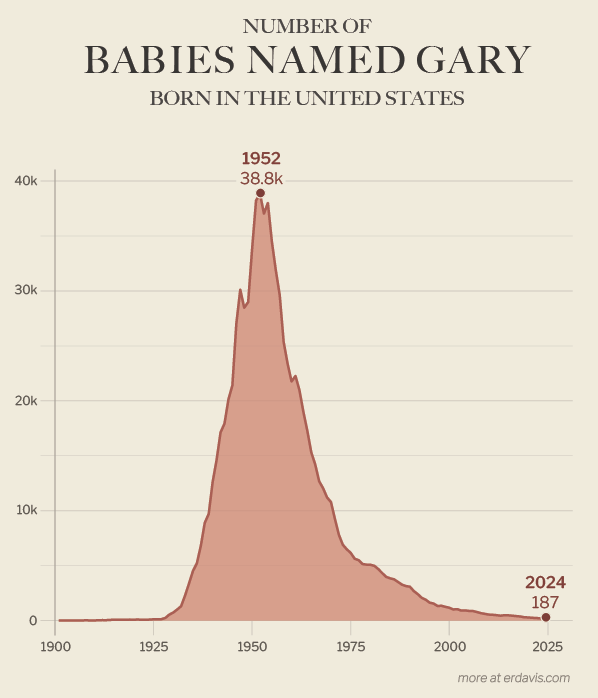
This story would float to the surface of my brain every now and then. (Side note: what does this say about me or my brain?) It stuck with me, in part, because I assume there’s a gigantic backlog of Garys to get through before the name actually goes exinct. There’s plenty of Gary runway! Why is everyone freaking out?
Naturally, this the perfectly weird sort of data story I like to investigate. Is the name actually going extinct if you consider not only the birthrate but also the backlog of living Garys? And if not, what names are most at risk?
How many living Garys are there? (warning: math)
To estimate the number of living Garys, I used the Social Security Administration’s cohort life tables. For a given year X, these tables estimate the share of people born in previous years that are still alive in year X. The data runs from to 1900 to 2050.
For example, these tables tell us that an estimated 81% of male babies and 88% of female babies born in 1952 (peak Gary) were still alive in 2024.
I then combined the life tables with Social Security Administration’s baby name data, which extends back to 1880, to estimate how many babies named Gary born before to year X are still alive in year X.
In pseudo-math:
Let GaryM,Y = male babies named Gary born in year Y
Let GaryF,Y = female babies named Gary born in year Y (yes, there are some)
Let SurvivalM,Y,X = probability that a male baby born in year Y is still alive in year X
Let SurvivalF,Y,X = probability that a female baby born in year Y is still alive in year X
The number of Garys born in year Y that are still alive in Year X is:
Surviving_GarysY,X = (GaryM,Y ∗ SurvivalM,Y,X) + (GaryF,Y ∗ SurvivalF,Y,X)
The total number of Garys still alive in year X is:
Surviving_GarysX = Sum of (Surviving_GarysY,X) for all years Y ≤ X
If that didn’t clarify it for you, my apologies, it’s going to get worse.
If it did help, congrats! You may have noticed a small flaw in this plan: baby name data only extend sback to 1880. Some Garys were almost certainly born before 1880 and were still alive in 1900. Those Garys would be missing from the estimate. The question is how to account for them.
The answer is the decennial U.S. census. Full-count census records, including names, are released after 70 years. I used the 5% sample available through IPUMS.
In this sample, each person is assigned a weighting variable indicating how many people in the full population they represent. After standardizing first names in R (to account for abbreviations such as “Wm.” and “Chas.”), I summed the weights for each Gary in the 1900 census. This yields an estimate of roughly 2,000 Garys alive in 1900, born between 1825 and 1900.
Now, I could combine that 1900 baseline data with the baby name data and get an answer. How many Garys are there?
So: how many Garys are there? (less math version)
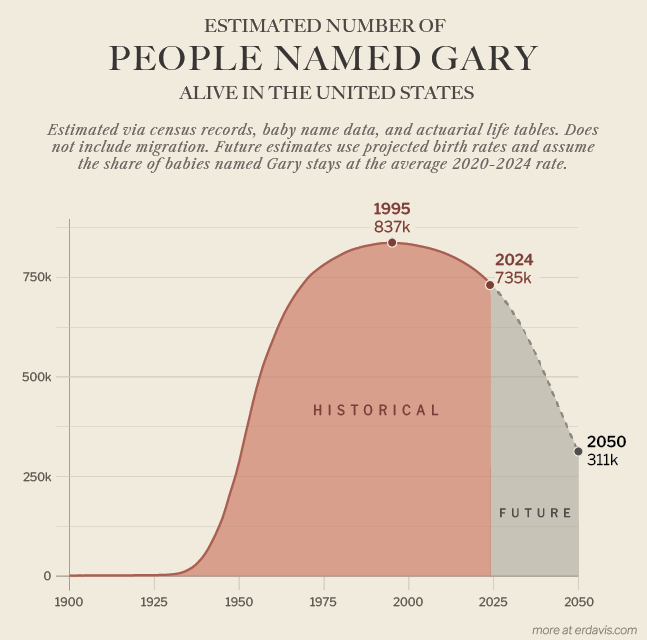
The projections through 2050 were calculated using the same method as the historical estimates. I assumed the average Gary birth rate from 2020–2024 would persist1, and applied that rate to projected birth data to estimate future Garys2.
You can see the Gary population is indeed falling. After Peak Gary in 1995, we’ve lost approximately 103,000 Garys.
Is the name at risk of extinction? The trend doesn’t look great, but I don’t think it’s terminal. Even 24 years from now, the projected number of living Garys would still be large enough to fill a city roughly the size of Pittsburgh or Cincinnati!
What names are most at risk of extinction?
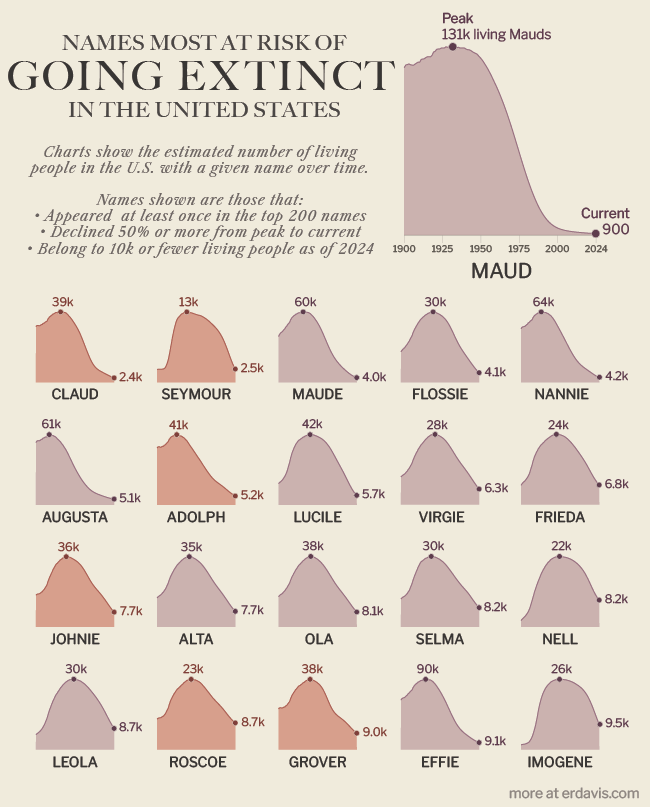
To answer this question, I applied the same calculations for every name that’s appeared at least once on the top 200 most popular names (by sex).
I defined “at risk of extinction” as the names with the smallest estimated living populations in 2024. To avoid edge cases, I limited the analysis to names that have declined at least 50% from their historical peak. This excludes names that briefly entered the top 200 but were never widely used.
What about my name?
Good news: I finally, finally moved my blog off of wordpress.com! I can embed custom interactives now, something my old site didn’t allow me to do!
Please enjoy this opportunity to explore the data and look up your own name:

Some final thoughts on design
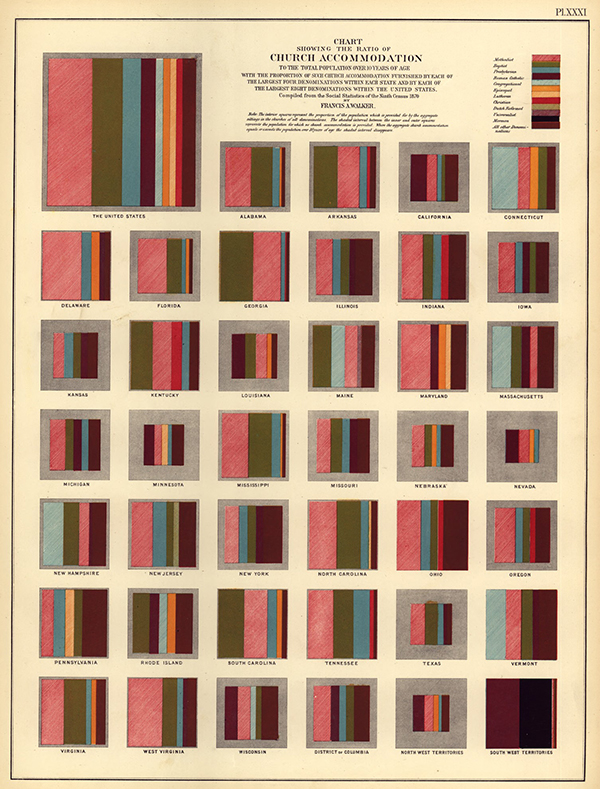
My styling goal for these charts was “1800s statistical atlas” – authoritative, somewhat verbose, and printed lithographically. I initially considered a more playful, pop-y palette, but the topic and the data sources really screamed for a more conservative visual direction.
I took a ton of inspiration from this set of pages from the 1870 census, particularly this amazing chart:
I absolutely love this style and probably will continue using it. I’ve been on a roll with name data recently (see: what is the most middle name and uncommonly common initials), so expect more on the topic… eventually!
Footnotes
- The Gary birthrate is trending to zero, so keeping it at the 2020-2024 average (roughly 1 in 10,000 male babies) is fairly optimistic. I played with fitting curves, but felt that might be assuming too much, particularly for names that are popular right now. I decided on this super simple metric as it’s easy to understand.
- This doesn’t account for migration. For a name like Gary that probably doesn’t matter much, but for names more common among migrant populations it probably matters a lot.
Discover more from Data Stuff
Subscribe to get the latest posts sent to your email.