This is my first personal vis project in nearly six months, and I wish I were posting it under happier circumstances.
Unfortunately, my employer, Axios, laid off half my team of extremely talented visual journalists. I wasn’t laid off, thankfully, but I’m heartbroken at losing these folks–they’re among the best in the business, and were not only amazing colleagues but great friends.
If you’re in need of data analysts, data visualizers, front end devs, illustrators, and/or graphic artists I will happily provide contacts for these folks.
The project
If you haven’t heard the term–I hadn’t, I had to google it–a “short story cycle” is a collection of linked stories, where events and characters in one short story affect events and characters in another.
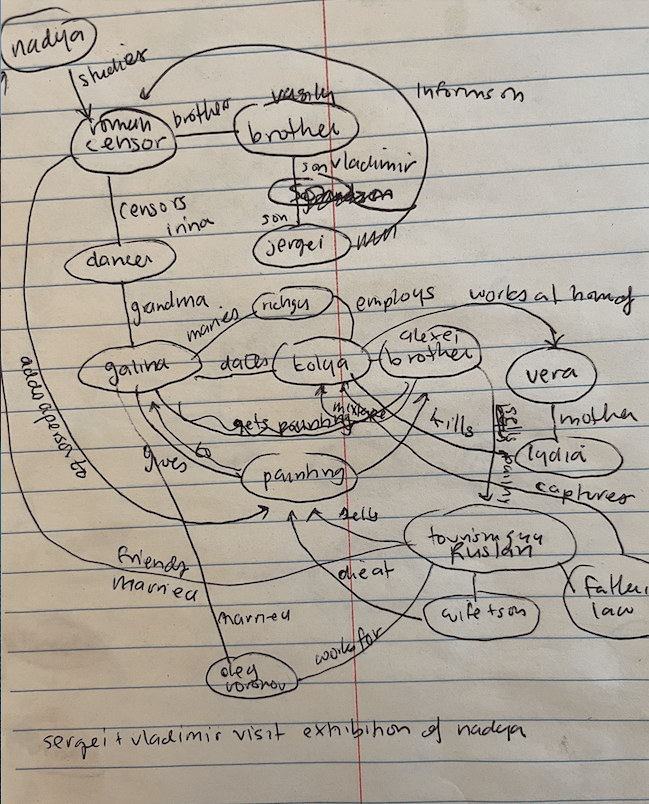
I aboslutely love these sorts of collections. Every time it’s revealed how one story connects to another it feels like a puzzle piece clicking into place. I recently re-read The Tsar of Love and Techno and found myself drawing a diagram to keep track of how the characters were related:
Naturally, I was like, hmm, this sounds like a cool dataviz project, and promptly read five more short story cycles to add to the pile.
As I read each, I sketched out a network diagram. I then went back through each diagram and tidided it up into an Excel sheet.
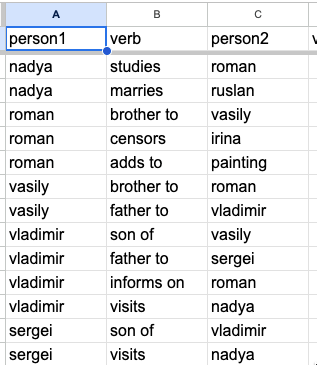
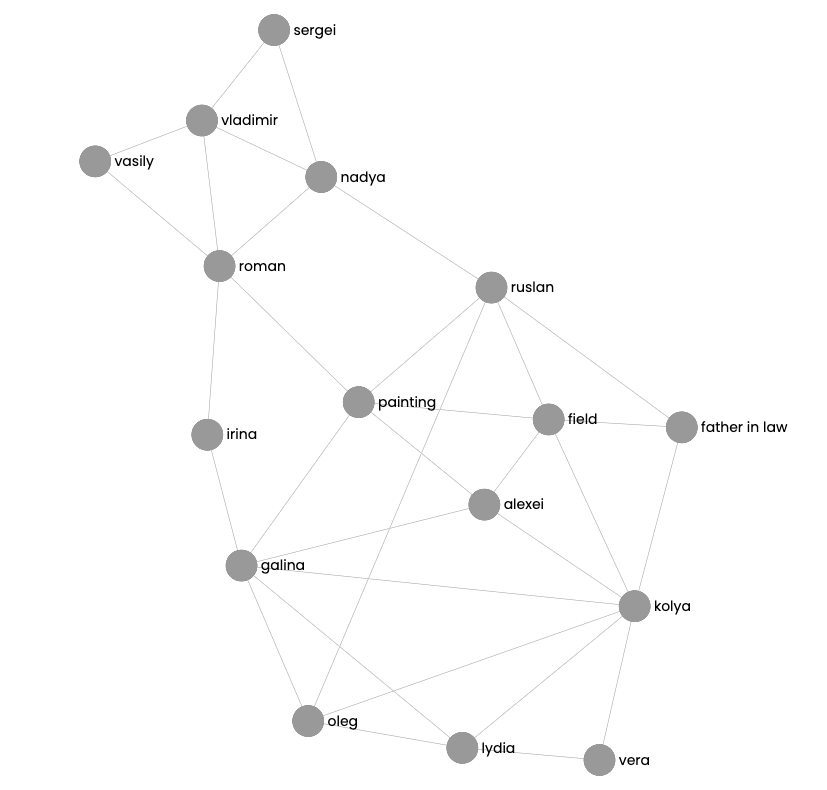
That was then easy to pop into Gephi to create a network diagram:
A bit of a caveat
I didn’t include every character in my diagrams. Ideally, every named character would be included, but that got really messy really fast.
I came up with some basic criteria for inclusion:
- Any character with a point-of-view chapter
- A non-PoV character linking two or more PoV characters
- Non-PoV character that was essential to the storyline
- this got a bit squishy, but I used my ~judgement~
If you’re the type of weird nerd that reads a lot of short stories and carefully studies network diagrams, and you disagree with who I added to these maps, feel free to let me know!
Finalizing the maps
My final step was to take the Gephi draft and pretty it up in Illustrator.
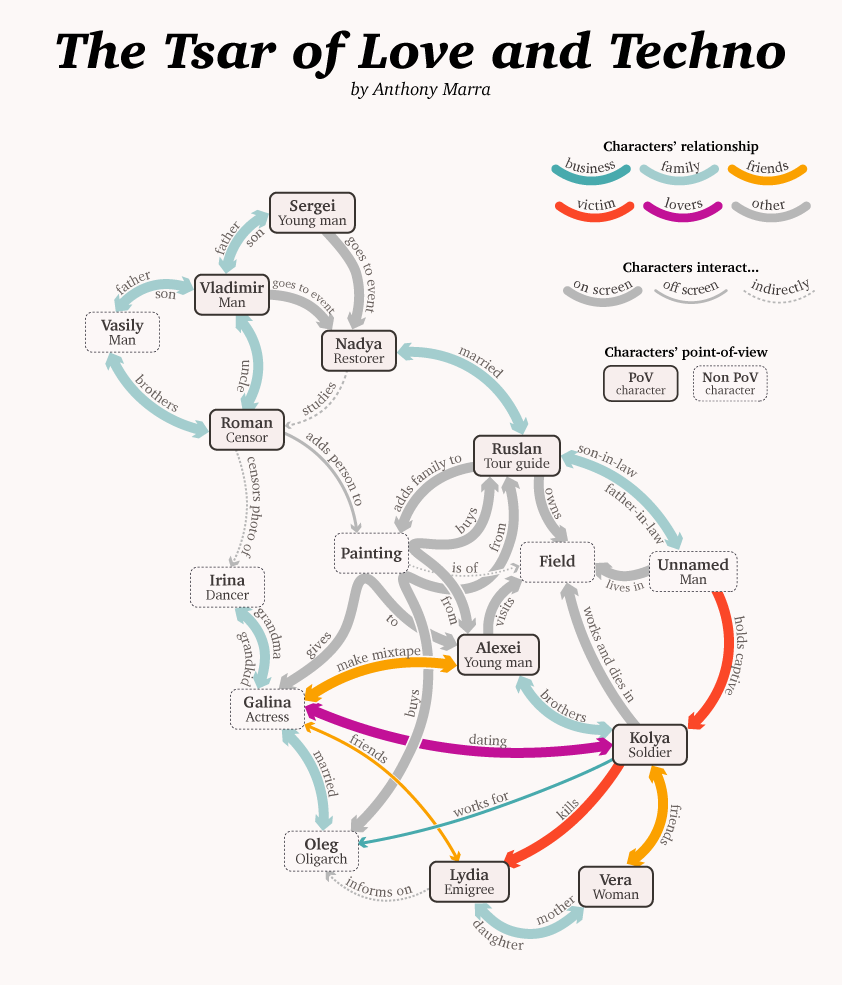
I wanted to have a few more layers of encoding than just straight links between characters, so I added three additional datapoints:
- Whether or not the character has a point-of-view chapter in the book
- What type of relationship two characters have
- I came up with six categories that covered the major categories of relationships in the books I read: friends, family, lovers, business-related, teacher/student, and perpetrator/victim
- I sorted bf/gf relationships into “lovers” (hot choice), as many of these relationships didn’t feel serious enough to include with “family”
- How the characters interact in the book
- On-screen: We see the characters interact directly on the page
- Off-screen: The characters don’t interact on screen, but we know that they know each other and have interacted directly before
- Indirectly: The characters may not meet, but their actions are linked
The final results (warning: spoilers)
(I don’t make any money from these Amazon links, btw, they’re for your convenience)
The Tsar of Love and Techno by Anthony Marra
Definitely the most complex of these diagrams. I struggled to show how the characters interacted with the painting that is central to the book, particularly as the characters give and take the painting to and from each other. I decided to have characters connected by lines that “touch” the painting node, but I’m afraid it’s not quite as clear as I’d hoped
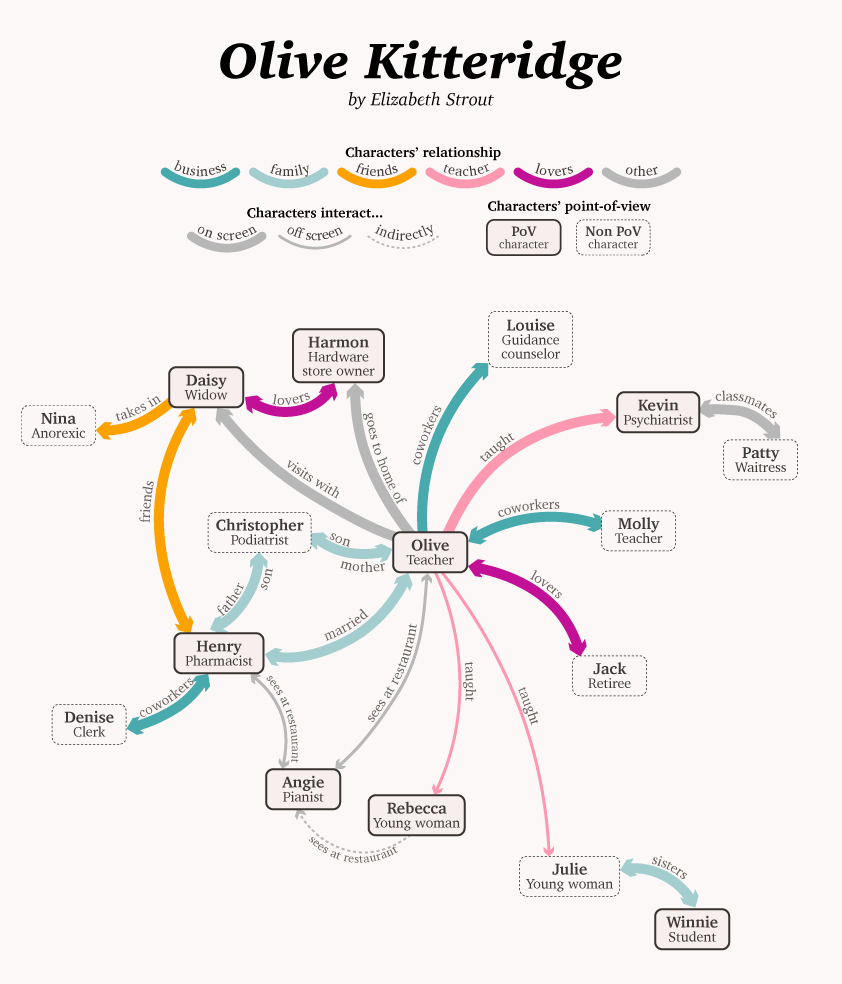
Olive Kitteridge by Elizabeth Strout
A classic of the genre. Once the last Lucy Barton book comes out next month I’m thinking of doing a map of the whole “Crosby-verse”: most of Strout’s books are eventually linked to the fictional town Crosby, Maine.
This was also a hard one to map, as many of the characters are connected only to Olive but not to each other. It was hard to pick who to include and who not, and I’m not sure if I fully agree with my decisions anymore.
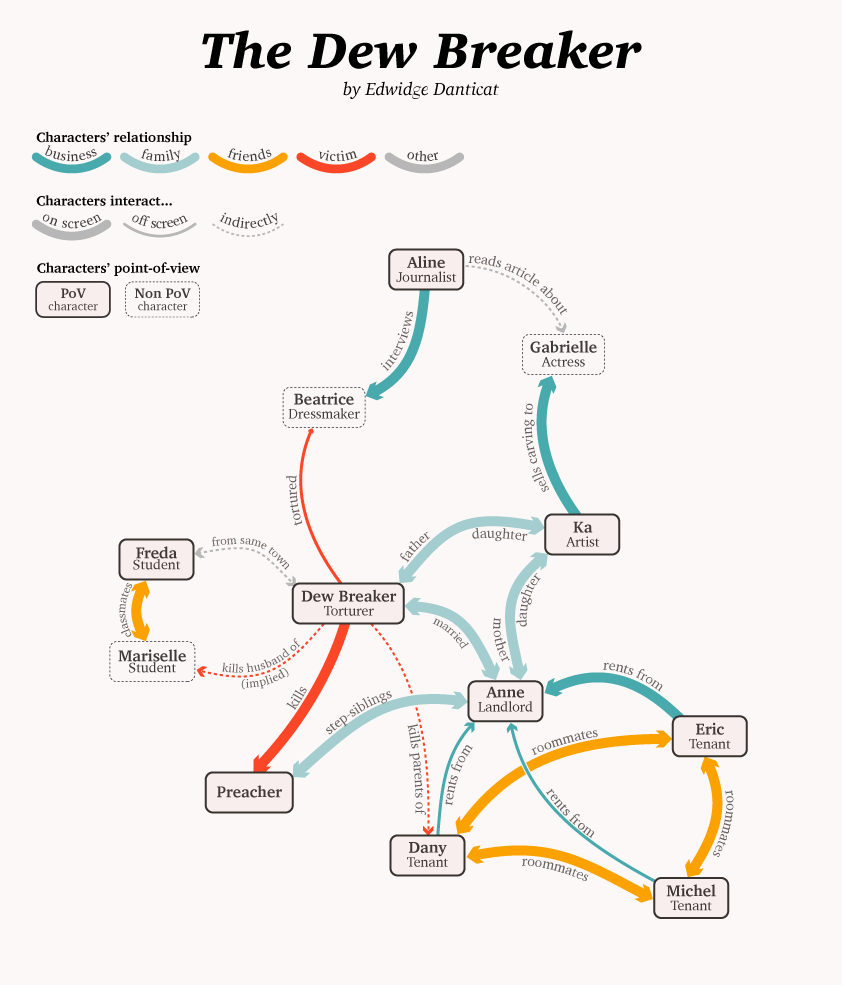
The Dew Breaker by Edwidge Danticat
A very concise diagram, and the main reason I had to include the victim/perpetrator relationship.
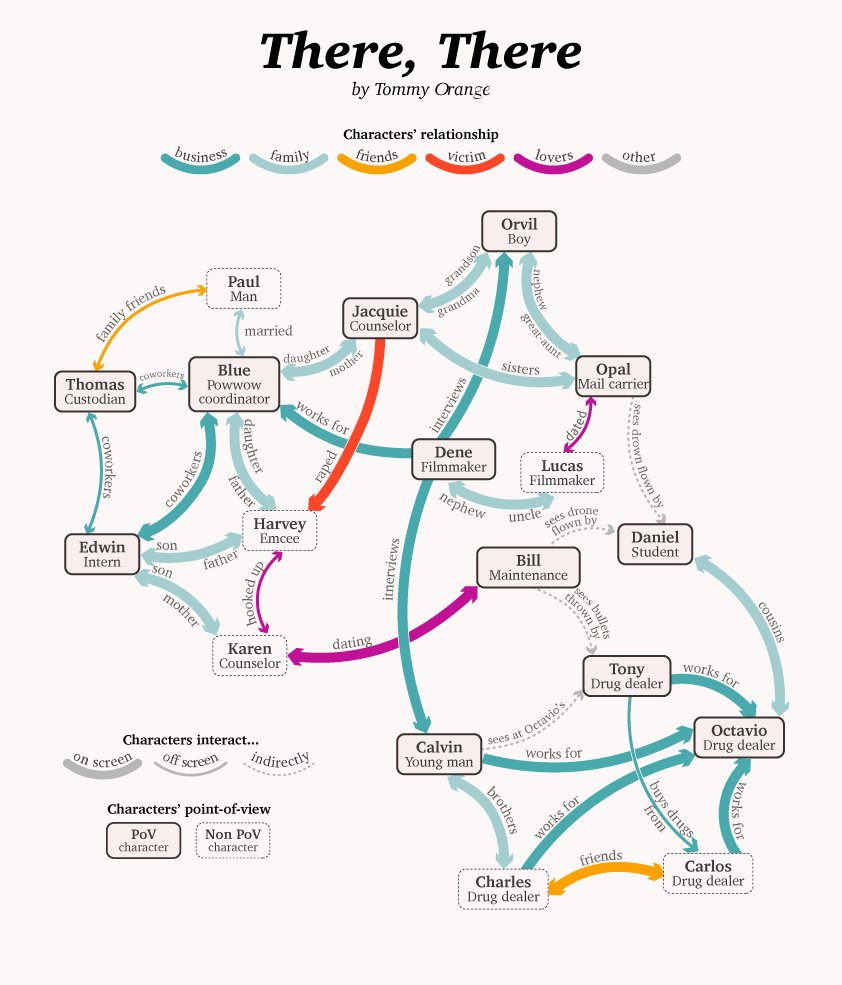
There, There by Tommy Orange
The second-most complex chart here, and probably my second-favorite (after Tsar) among the books. Many of the characters are searching for their families, whether literally or figuratively, and the dominance of light blue shows that.
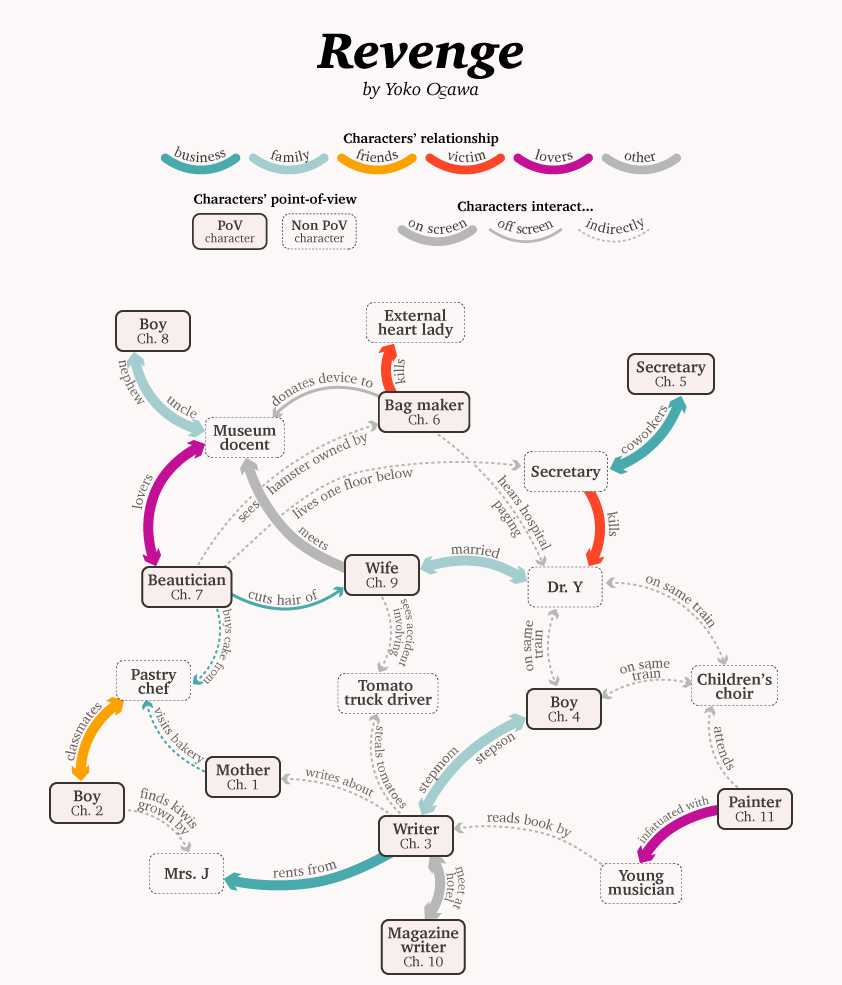
Revenge by Yoko Ogawa
I have to admit, I didn’t particularly enjoy this collection. It’d be great for lovers of magical realism, which isn’t really my bag. It is interesting to see just how indirectly most of the characters are connected: far more of them never meet face-to-face than any of the other books I read.
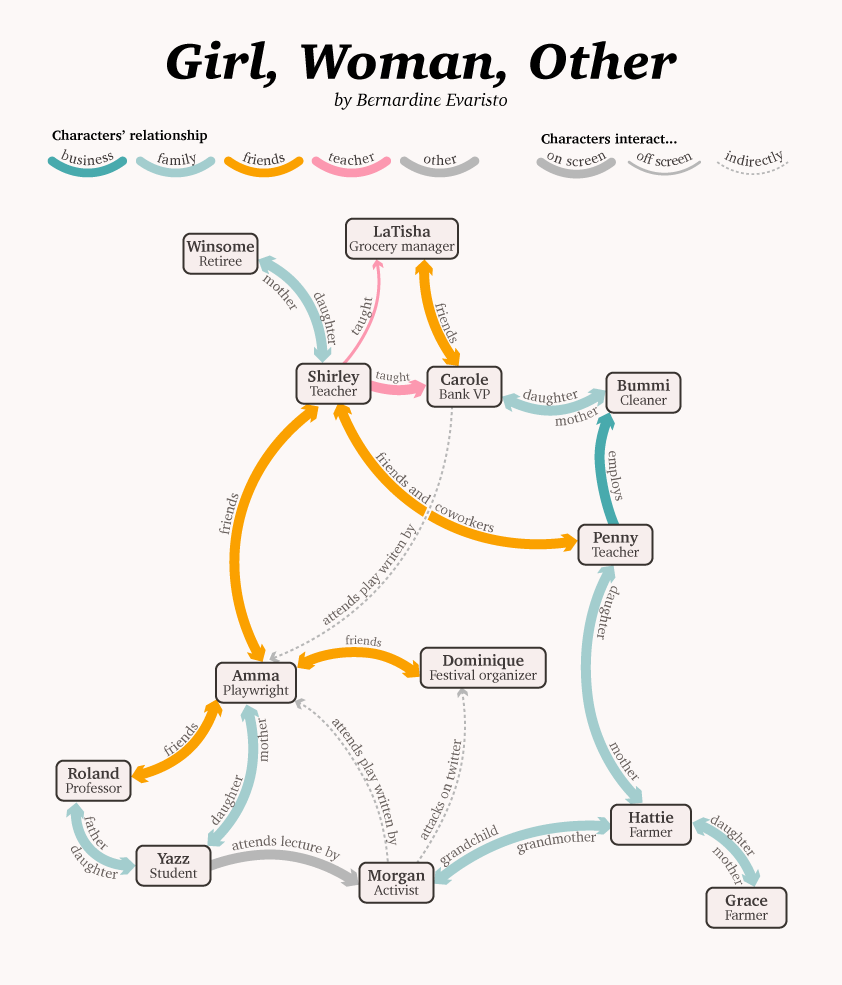
Girl, Woman, Other by Bernardine Evaristo
This wasn’t marketed as a collection of short stories, but it reads as one. I loved this book, and I love that I could make this chart without including any non-PoV characters.
 Data Stuff
You have a very creative mind that sees the world in a unique and interesting way. That you can express all this via data viz is fascinating! More, please!
LikeLike
Your post inspired me to read The Tsar of Love and Techno—I’d never heard of it, but your diagram inspired me to pick it up (I love these kind of time/generation-sprawling stories, and also sometimes find myself with a notebook alongside to keep up) and I adored it. The way that you placed the painting and the field as characters is perfect—really illustrates how they tie everything together. Thank you for sharing this creative and thoughtful work!
LikeLike
[…] Unraveling character webs. I love the diagrams and don’t know any of the books. (via) […]
LikeLike
thank you for this character map for There there! Just finished listening to the audio version and needed that!
You wwould probably love Jennifer Eagan’s A Message from the Goon Squad, and it’s later addition, the Candy House. Great books with wild character connections.
LikeLike